Article by Jacqulyn Clarke-Rathjen, 1986 alumnus and former Rustler Feature News Reporter

Fremont, Nebraska's Normal School, captured around 1899, showcases its original building from 1884 prominently in the foreground, distinguished by the observation tower. To the far right, an addition from approximately 1890 can be seen, marked by a third tower.

Fremont Normal School (1915)

Did You Know? Fremont High School Was Founded in 1889
Modern Fremont High School is a vibrant educational hub, currently serving over 1,700 students. Its storied legacy commenced with the inaugural graduation ceremony in 1893. Named after the daring frontier explorer General John C. Fremont, the school has maintained a steadfast commitment to educational excellence, reflecting the adventurous spirit of its namesake.
The history of Fremont High dates back to 1856, when George Finney made the first land claim in the area, sparking growth in the 1870s, particularly with the advent of the Union Pacific's main rail line. By the late 1880s, secondary education had firmly taken root, culminating in the graduation of the inaugural class of nine students from the Fremont Normal School & Commercial Institute in 1893. Initially located in a building constructed in 1889 for $23,000 on Eighth Street between Main and D Streets, the school quickly outgrew its facilities due to rising enrollment. The escalating costs of renting additional spaces prompted the need for a new facility, leading to the construction of a new campus at 130 E 9th Avenue in the early 1900s.
The original Fremont Normal School building suffered fire damage in 1907. Although it was repaired, it remained unsuitable for the growing number of students, amplifying the urgency to find a new campus. This structure eventually became part of Midland College in 1919, remaining in operation until it was demolished in 1985.
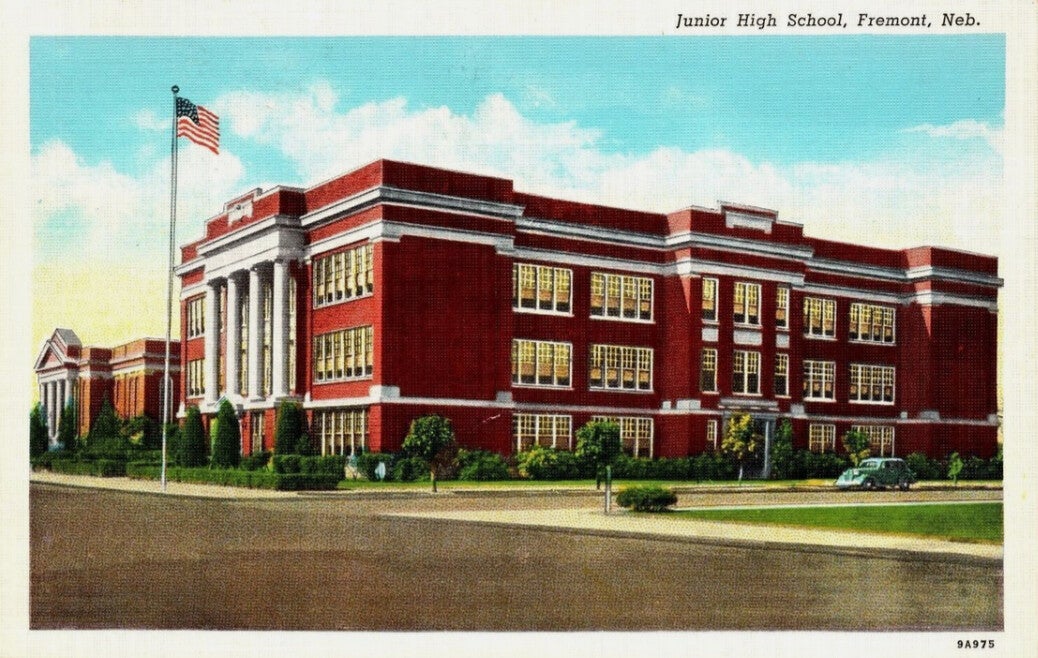
Designed by architect Albert Henry Dyer, a prominent figure in Fremont, Nebraska, known for his vision in historical development over several decades. The new Fremont Senior High and Junior School buildings were erected between March 18, 1913, and April 8, 1914, officially welcoming students in the fall of 1914. These modern facilities aimed to provide a comprehensive, vocationally-focused curriculum that addressed the educational needs of an industrializing society. The establishment of John C. Fremont Park adjacent to the Senior High campus further enriched the community by offering green space for recreation and gatherings, solidifying the school's role as a cornerstone of local engagement.
With the population of Fremont continuing to grow during the late 1940s to early 1950s, the high school campus at 9th Avenue and Broad Streets expanded to accommodate the increasing number of Senior High students, surpassing previous capacity expectations.

In 1956, plans were revitalized for a new senior high school campus located just east of town—known presently as Lincoln Street. This area was experiencing development, with several residential homes under construction, except for the proposed site secured by the school’s development authority. By late 1956, designs were being crafted by Davis & Wilson, Architects from Lincoln, Nebraska. Fremont Senior High School officially opened its doors in 1958. Alongside this development, the original campus on 9th Avenue was renamed Fremont Junior High School to help alleviate the overcrowding of junior high school students at the Broad Street campus.
The significance of Fremont Junior High School is deeply connected to its original facility, which had operated since 1914, previously serving both senior and junior high school students. In 1978, following a bond approval on April 4, the Lenihan Building and Skywalk were added to the existing structure to enhance educational facilities, funded alongside the Milliken Park Elementary School project. The Lenihan Building was officially completed in 1975 after groundwork began around 1973.
The Lenihan Skywalk, which linked the junior high school to nearby educational buildings across State Highway 77 (Broad Street), opened in 1979. It provided a safe passage for students, particularly for the Class of 1985, the first to make the transition from elementary to junior high. During the skywalk's construction, students used designated outdoor pathways and a signal-light crosswalk at the Fremont City Auditorium to navigate safely between buildings.
Commonly referred to by locals as the "Gerbil Run" due to its distinctive curved glass top and yellow metal strips, the skywalk became a cherished feature, protecting students from inclement weather and traffic for over four decades.
This reconfiguration remained in place until 2003, when the school district initiated a significant reorganization of its facilities. The former junior high campus transformed into the Fremont Public Schools Administration Building on the 9th Avenue campus, signifying the district's commitment to adapting educational structures to better serve the community. Meanwhile, the Broad Street campus was acquired by Metropolitan Community College.
With improvements and developments for John C. Fremont Park scheduled for the fall of 2025, the demolition of the Lenihan skywalk was completed in March 2024, marking the end of an era for this iconic structure within the Fremont School District. Throughout its rich history, Fremont High School has served not only as a beacon of academic achievement but also as an integral part of the Fremont community's identity and sporting legacy in contemporary times.